
- 26 Feb, 2026
- read
OpenClaw Gateway Hardening and Operations on AWS
This project documents how a default OpenClaw setup was converted into a safer operational deployment. The core focus was reducing control-plane fragility: auth mismatch failures, remote access confusion, and manual deployment risk.
Why this mattered
The deployment worked initially, but daily operations exposed predictable pain points:
- Gateway auth drift created intermittent
unauthorizedfailures. - Remote connectivity assumptions around bind/transport were inconsistent.
- Website updates were manual and easy to break.
Goal: keep operations simple while enforcing safer defaults.
Gateway bind and auth model
OpenClaw bind behavior must follow platform-supported modes, not raw socket assumptions. For broad interface listen, bind: "lan" maps to 0.0.0.0. Non-loopback exposure requires shared-secret auth.
{
  "gateway": {
    "mode": "local",
    "bind": "lan",
    "auth": {
      "mode": "token",
      "token": "<redacted>"
    }
  }
}
Auth mismatch failure mode
The most common outage pattern was gateway token mismatch between server auth and remote client settings.
# Known-good parity check
openclaw config get gateway.auth.token --json
openclaw config get gateway.remote.token --json

# If mismatched, reset both to same value then restart
openclaw gateway restart
This removed repeated gateway closed (1008): unauthorized failures in normal admin workflows.
Safe remote access notes
Direct plaintext remote control flows are error-prone and unsafe. Operationally, stable patterns were:
- Loopback + SSH tunnel for low-friction secure control.
- TLS-backed access patterns when remote direct access is required.
Practical outcome: fewer connection-policy surprises and cleaner troubleshooting.
Website delivery pipeline
The site was hosted on S3/CloudFront without clean source provenance. Workflow was rebuilt around a managed local copy plus scripted deploy.
# deploy flow (simplified)
python3 scripts/render_projects.py
aws s3 sync site-managed/ s3://<bucket> --delete
aws cloudfront create-invalidation --distribution-id <id> --paths '/*'
Before high-impact changes, a full static snapshot was taken for recovery.
IAM gotcha encountered
Initial deploy failed because object write permissions were incomplete. Required actions included bucket list + object read/write/delete + CloudFront invalidation.
{
  "Action": ["s3:ListBucket", "s3:GetObject", "s3:PutObject", "s3:DeleteObject", "cloudfront:CreateInvalidation"],
  "Effect": "Allow"
}
Results
- Auth-related gateway interruptions were eliminated after token parity standardization.
- Deploy and content update process became deterministic and script-driven.
- Rollback confidence improved via pre-change backups.
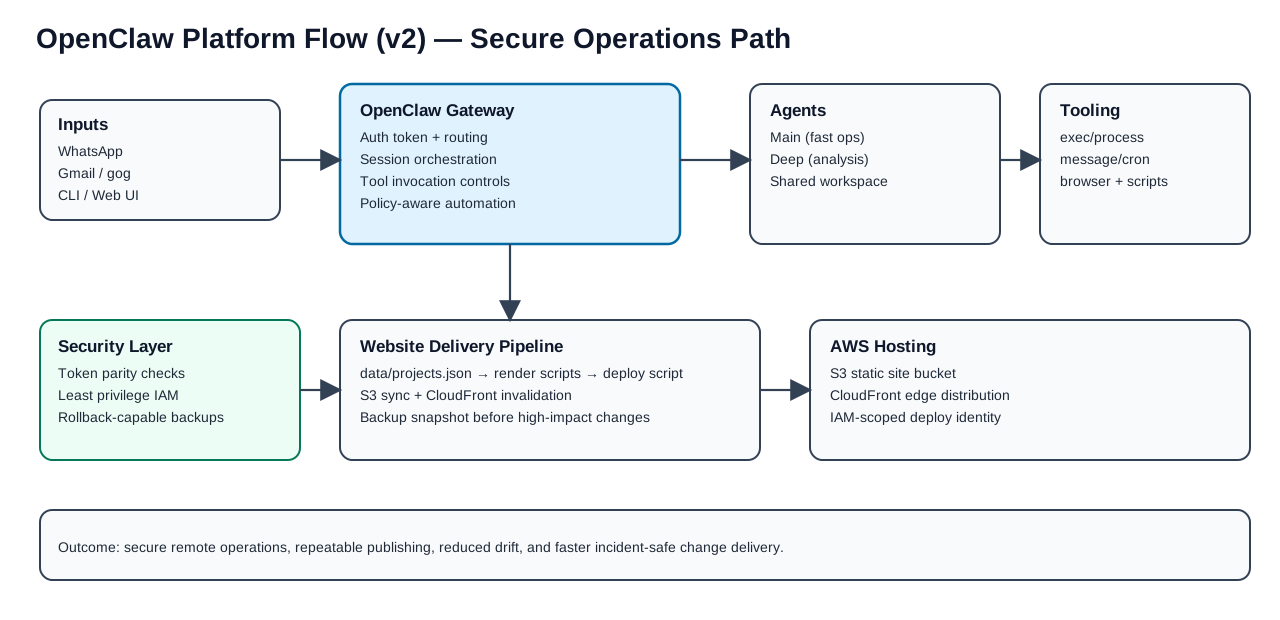
Architecture Diagram
Sanitized note
No secrets, tokens, or internal identifiers are included here. This page focuses on implementation patterns and operations lessons.